

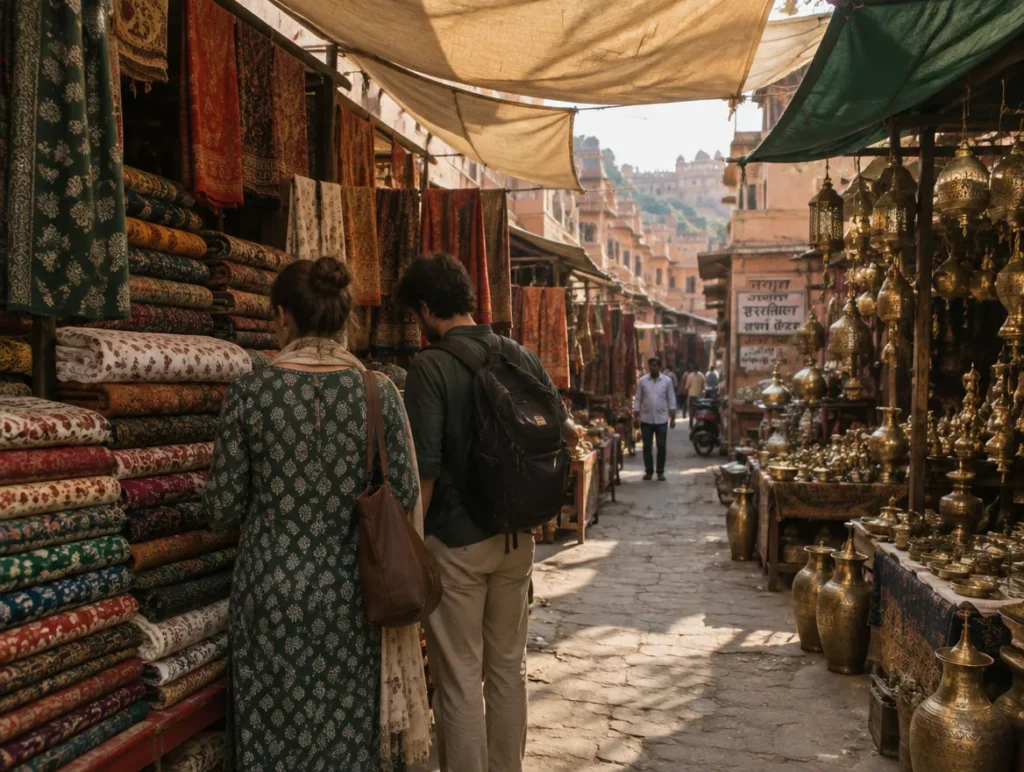
Jaipur’s walled city is a grid, which is unusual for an Indian old town and enormously helpful for walking it. It was laid out in the 1720s on a nine-block plan, with the main bazaars running along the principal axes. Once you understand the grid, the markets stop being a confusing tangle and become a route.
The order below matters. It follows the light, the opening hours and the natural downhill of your energy across a day.
Start: Tripolia Bazaar, around 10am
Begin on the east-west axis near Tripolia Gate. This is the wholesale-leaning end: lac bangles, brassware, ironmongery. Shops open later here than you might expect, so 10am is early enough.
The reason to start here is that it is the least pretty stretch and the most working. Doing it first, while you are fresh and before the crowd builds, means you see the actual trade rather than queueing behind it.
Off Tripolia runs Maniharon ka Rasta, the lane of the bangle makers, where lac bangles are still made by hand over small flames. Watch before you buy; the making is the interesting part.
Second: Johari Bazaar, late morning
Walk east to Johari Bazaar, the jewellers’ market and the most famous of the five. Gold, silver, and the kundan and meenakari work Jaipur is known for.
Late morning is right because the shops are fully open, the light in the arcades is good, and you have not yet got market fatigue, which matters here because jewellery buying requires patience and attention.
A word on buying: hallmarking is the thing to check, and the price of stones is where the variation lives. If you are not confident, treat the first visit as looking and come back. Nobody serious will mind.
Third: Bapu Bazaar, early afternoon
South, into Bapu Bazaar. This is the textiles and footwear market: block-printed fabric, quilts, mojris, and the bulk of Jaipur’s tourist-facing shopping.
Early afternoon suits it because the arcades are covered and shaded, which they need to be. This is also where the bargaining is most expected and most theatrical. A reasonable opening position on non-fixed-price goods is well below the first quote; walking away is a normal part of the conversation rather than an insult.
Adjoining it is Nehru Bazaar, effectively the same market with a heavier emphasis on juttis and printed cloth. Treat them as one stop.
Fourth: Kishanpole Bazaar, mid afternoon
West along the southern edge to Kishanpole, which is the woodwork and marble market, with a long association with sandalwood and carved furniture.
This is the quietest of the five and the best one to be in when your legs have gone. It is also where the least-hurried conversations happen, because the goods are slower to sell.
Fifth: Chandpole Bazaar, late afternoon into evening
Finish north-west at Chandpole. Marble carving, idols, and a more local, less visitor-oriented crowd than the other four.
End here because the light is good on the pink facades late in the day and because Chandpole Gate puts you in reach of the Hawa Mahal side of the city for the evening, when the buildings are lit.
Practical notes for the walk
- Total distance is roughly five to six kilometres of actual walking, spread over a day. Comfortable shoes matter more than they sound like they should.
- Sunday closes a large share of the walled city’s shops. Do not plan this walk for a Sunday.
- Heat. April to June makes a full-day walk genuinely unpleasant. October to March is the window.
- Traffic. The bazaars are active roads, not pedestrian zones. Walk the arcades, not the carriageway.
- Cash. Widely used and often gets a better price than card, though UPI is now accepted almost everywhere.
- Touts and commissions. A driver or guide who insists on a particular emporium is earning a commission, which you are paying. Politely decline and walk.
If you only have a morning
Do Johari and Bapu. They are adjacent, they cover jewellery and textiles, and they give you the clearest sense of what the walled city sells. Save the rest for a return trip.