

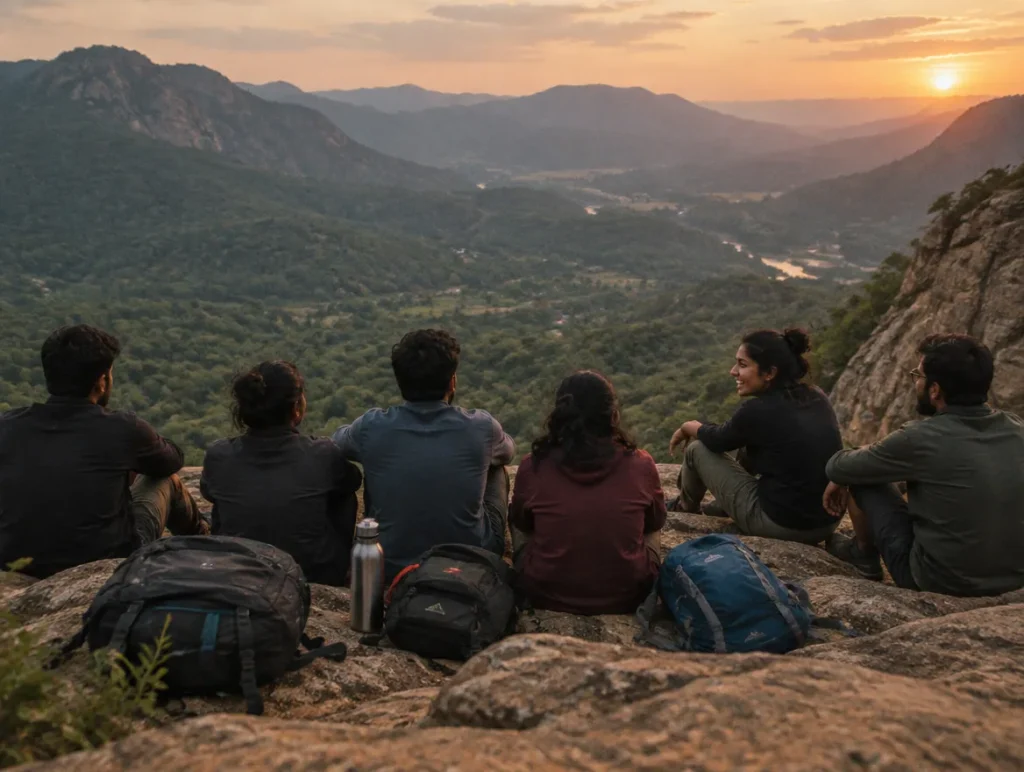
Most people who say they dislike group travel are describing one specific format: forty-odd strangers, a coach, a flag, a fixed schedule and a shopping stop that exists because of a commission. That format deserves its reputation.
But the alternative most people reach for instead – everyone books their own everything and coordinates by group chat – fails differently and more often. Here is what actually determines whether travelling with a group is good.
Group size is the whole game
There is a threshold, and it is lower than people expect.
Up to about six can make decisions standing on a street corner. One table at any restaurant. One vehicle. Nobody gets lost.
Eight to fourteen still works but needs structure: decisions made the night before, not in the moment. Two tables. Usually two vehicles.
Above about sixteen, the group becomes a logistics problem that requires a full-time person to solve, and every single unplanned decision costs twenty minutes. This is the size at which the coach-and-flag format becomes the only workable one, which is why it exists.
If you want group travel that does not feel like group travel, the most effective single lever is keeping the number under fifteen. Everything else is secondary.
Decide what is fixed and what is free, out loud
The trips that go wrong are the ones where this was never discussed and everyone assumed a different answer.
A structure that works: one fixed anchor a day, and the rest genuinely optional. Everyone knows where the group will be at 9am and where dinner is. In between, people can split off without negotiating or apologising.
The failure mode in the other direction is a trip where everything is optional. That sounds liberating and in practice produces a daily hour of nobody wanting to decide.
Talk about money before you go, specifically
This is the most common thing that sours a group trip, and it is entirely preventable.
Agree in advance:
- What is in the shared pot and what is individual. Transport and accommodation in; drinks and shopping out, usually.
- The rough nightly budget for food. Not to police it, but because a group containing one person who wants street food and one who wants a tasting menu needs to know that before dinner, not at it.
- Who pays upfront and how they get repaid. One person fronting everything and chasing eight people for two months afterwards is how friendships get damaged.
- What happens if someone drops out. Non-refundable bookings split across fewer people is a real cost and it needs a rule agreed while everyone is still enthusiastic.
A shared spreadsheet or a splitting app, updated daily rather than at the end, removes almost all of this.
Rooming is not a small detail
Twin sharing is the default in group travel because it halves the accommodation cost. It is also the thing people are least honest about wanting until they are in the room.
Ask directly whether people want a single supplement, and make it available without it being awkward. Someone who sleeps badly in a shared room will be a different person by day four.
Pace is a compatibility question, not a preference
The traveller who wants to be out at 6am and the traveller who wants a slow breakfast are not in conflict about any particular morning. They are in conflict about the entire trip.
This is worth surfacing at the planning stage with a direct question: on a free day, what time do you want to leave the hotel? The answers will cluster, and if they cluster into two distinct groups, plan for the group to split most days rather than pretending it will not happen.
One person should be responsible, and it should be named
Not a leader making decisions for everyone. Someone who holds the bookings, knows the plan, and is the point of contact when something goes wrong.
Groups of friends often resist this because it feels hierarchical. The result is that the most conscientious person ends up doing it anyway, without acknowledgement, and resents it. Name it, and if it is a long trip, rotate it.
Build in time apart
The single most underrated element of a good group trip is a scheduled afternoon where nothing is planned and nobody is expected to be with anybody.
Two weeks of continuous company is a lot even among people who like each other. A half-day off restores the group more than another shared activity would.
The questions to ask a group trip before you book one
If you are joining an organised departure rather than assembling your own:
- How many travellers, maximum? A vague answer is an answer.
- How many are typically solo travellers versus existing pairs? A group of six couples and one solo person is a specific experience.
- What is the age and life-stage mix? Not to filter, but to know.
- How many hours on the road on the longest day? The itinerary rarely says.
- Is there a single supplement, and what does it cost?
- Are there shopping stops, and are they commissioned? An honest operator will say plainly.
- What is genuinely optional? If the answer is nothing, it is a coach tour with better photography.