

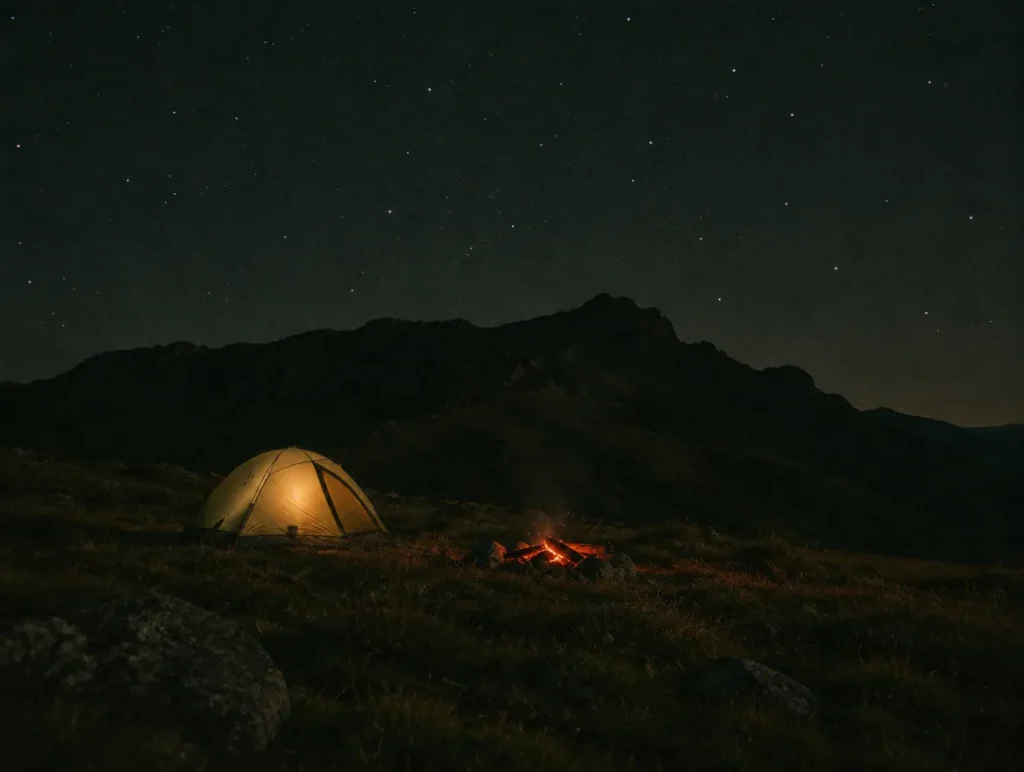
Camping near Delhi has a marketing problem. A lot of what is sold as a camping weekend is a tent pitched in a resort compound with a DJ running until midnight. That is a fine thing to want; it is just not what most people picture when they book it.
Here is an honest map of what is actually within reach of Delhi, what each area is really like, and how to tell the difference before you pay.
Two to three hours out
The Haryana Aravallis, around Damdama and Sohna. The closest option, roughly an hour and a half in decent traffic. Low rocky hills, a lake, and a cluster of adventure-camp operations. Realistically this is a facility weekend rather than a wilderness one: expect zip lines, groups, and neighbours. It works well for a first camp with children or for a Saturday night that does not need a day of driving.
Morni Hills, near Panchkula. Further, around five hours, and noticeably quieter. The first proper hills on the route north, with pine and two lakes. Less developed, fewer operators, more of a sense of having left.
Four to six hours out: where it starts being worth it
Shivpuri, on the Ganga near Rishikesh. The classic Delhi camping weekend and still the best value for the drive. Riverside beach camps, rafting from September through June, and the sound of the river instead of a generator. The stretch is busy and the camps sit close together, so the difference between a good and a mediocre weekend here is entirely which operator you pick and how far upstream they are.
Kanatal and Dhanaulti, above Mussoorie. Around seven hours but at genuine altitude, roughly 2,500 metres, in deodar forest. Cool even in May, cold in winter, and quiet in a way the river camps are not. This is the area to choose if the point of the weekend is silence.
Chail, Himachal. Around seven to eight hours. Pine forest, the well-known high cricket ground, and enough of a town to have somewhere to eat. Good middle ground between wilderness and having options.
A long weekend, not a weekend
Pangot and the Nainital ridge. Eight hours or so. Oak and pine forest at around 2,000 metres, and one of the better birding areas in the north. Go for three days or do not go.
Bir, Himachal. Twelve hours by road, which makes it an overnight-bus trip rather than a drive. Worth listing because it is the one people keep pushing into a two-day window and should not. Paragliding, tea gardens, a Tibetan settlement, and a pace that needs four days.
How to tell a real camp from a resort with tents
Ask these before booking. The answers are usually revealing.
- How many tents on the site? Under fifteen is a camp. Fifty is a venue.
- Is there a sound system, and until when? The honest ones will tell you straight.
- What is the bathroom arrangement? Shared built bathrooms are normal and fine. Knowing in advance prevents most of the complaints.
- Do you take group bookings the same night? One corporate offsite changes the character of a small site entirely.
- How far is the nearest road? If the answer is “you can park at your tent”, adjust expectations accordingly.
Season, plainly
October to March is the good window for everything below about 2,000 metres, including the Aravallis and the Ganga camps. April and May are hot near Delhi and pleasant higher up. The monsoon, roughly July to September, is the one to avoid for riverside camping specifically: water levels rise fast and beach camps close for good reason. Ignore anyone still selling a Ganga beach camp in August.
What to carry that people forget
- A warm layer, even in summer, for anywhere above 1,500 metres. Nights drop further than the forecast suggests.
- A headtorch rather than a phone light.
- Cash. Card machines and connectivity are unreliable.
- Your own sleeping-bag liner if you are particular. Camp bedding varies.
- A power bank. Site electricity is often a few hours on a generator.
One last thing: whatever you carry in, carry out. The Aravalli and Ganga sites are visibly suffering from weekend traffic, and the camps that are strict about this are the ones worth giving your money to.