

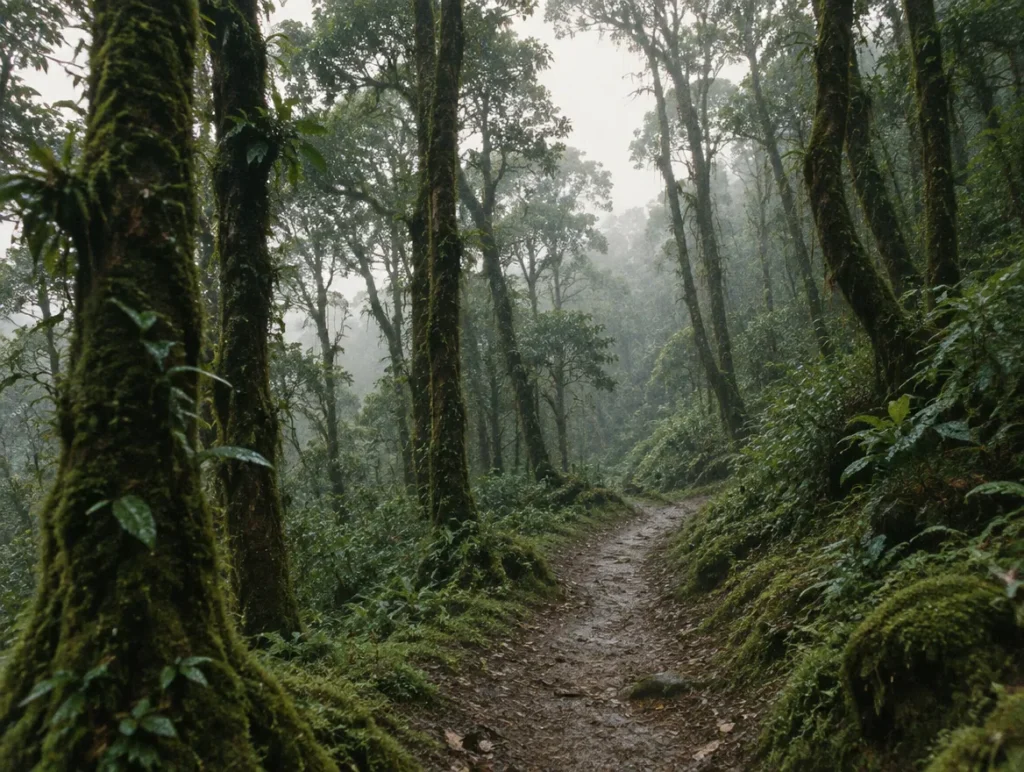
The living root bridges of Meghalaya are made by training the aerial roots of the rubber fig across a stream over decades until they thicken into a load-bearing span. There are dozens across the Khasi and Jaintia hills, and they are among the few genuinely unique things in Indian travel.
They are also frequently done badly: in the wrong season, at the wrong bridge, in a single rushed day. Here is how to get it right.
When to go
This is the decision that matters most, and the popular answer is wrong.
Meghalaya is one of the wettest places on earth. The Sohra and Mawsynram area receives extraordinary annual rainfall, concentrated between roughly June and September. In peak monsoon the waterfalls are spectacular and the trails are dangerous, the streams under the bridges run high, and visibility collapses into cloud for days.
The best window is late September to November. The rain has eased, the falls are still running hard, the forest is green, and the trails are walkable. October is close to ideal.
December to February is dry, cool and clear, with the lowest crowds, but the waterfalls are much reduced.
March to May is warm and increasingly humid, with pre-monsoon storms.
June to August is the season to avoid unless rain is specifically what you have come for. Leeches are abundant, steps are slick, and flash flooding closes trails.
Which bridge, honestly
The double-decker at Nongriat is the famous one and the one worth the effort. It is reached by descending roughly 3,000 steps from Tyrna village, and then climbing them again. This is not a walk; it is a long stair descent with a long stair ascent at the end, and it punishes knees more than lungs.
Do it as an overnight. Stay in Nongriat, walk on to the nearby pools in the afternoon, and climb out the next morning while you are fresh. Doing it as a day trip from Shillong means arriving tired, spending twenty minutes at the bridge, and climbing out in the heat. That is the version most people do and the version most people describe as underwhelming.
The single bridge at Riwai, near Mawlynnong, is a five-minute walk from the road. It is genuinely impressive and takes almost no effort, which makes it the right choice for anyone who cannot do the Nongriat steps, and a reasonable addition for everyone else.
Mawlynnong village itself is marketed heavily as Asia’s cleanest village. It is pleasant and it is a managed visitor experience. Half an hour is enough.
What to skip
The Shillong-based single-day tour that promises Sohra viewpoints, a cave, Mawlynnong and a root bridge. It is eleven hours in a vehicle with four short stops, and you will see the Riwai bridge for fifteen minutes. If that is your only option it is better than nothing, but it is not the thing itself.
Also skip the roadside viewpoint stops in heavy cloud. Between June and August the famous Sohra viewpoints frequently show you a wall of white, and the entrance fees add up for nothing. Ask about visibility before paying.
The steps, realistically
Down to Nongriat takes most people between an hour and a half and two and a half hours. Up takes longer, commonly two to three and a half. The steps are uneven stone and concrete, wet in places, with two steel suspension bridges on the way.
What helps: trekking poles or a stick, shoes with real grip rather than trainers, and going down slowly. Almost all the knee damage happens on the descent, because it feels easy.
Porters are available at Tyrna and it is normal and reasonable to hire one.
Staying at Nongriat
Accommodation in the village is basic homestay and guesthouse: shared bathrooms, limited electricity, no mobile signal for most networks. That is the appeal. Carry cash, because there is nowhere to withdraw it, and carry a headtorch.
Book ahead in October and November. There are not many beds.
Respecting the bridges
These are living structures maintained by the villages that built them, over generations. Two things matter: do not carve or pull at the roots, and pay the small village entry fees without haggling. They fund the maintenance that keeps the bridges alive.
Getting there
Fly to Guwahati, then road to Shillong, roughly three to four hours. Sohra is another two from Shillong, and Tyrna a further half hour. Give the region four days minimum. Two days is a road trip with a bridge in it.