

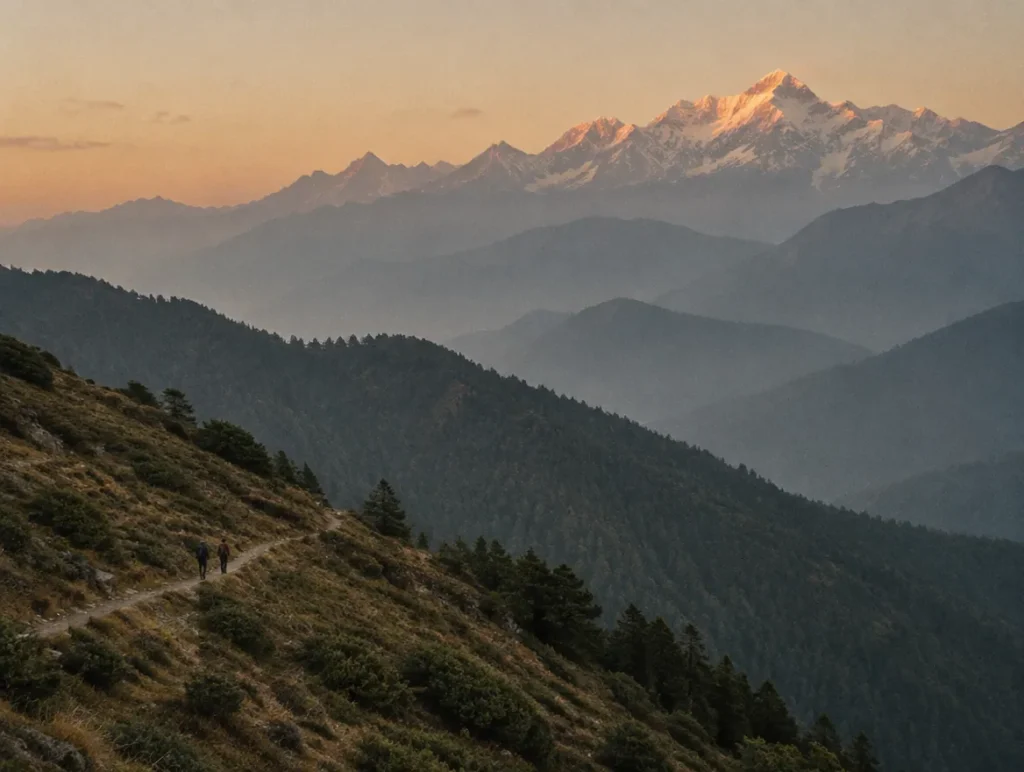
Himachal has a guide industry, and for some routes it is entirely justified. For others, hiring a guide is buying reassurance rather than safety. Knowing which is which saves money and, more importantly, changes how the walk feels.
These six are all routes where a reasonably fit walker with a map, a weather check and some sense can go unguided. That is not the same as saying they are easy. Read the caveats.
1. Triund, above McLeod Ganj
The standard first Himalayan trek, and deservedly so. Roughly nine kilometres up from Dharamkot through oak and rhododendron to a ridge with the Dhauladhar range directly above you. The path is wide, obvious and busy. You cannot meaningfully get lost.
Do it as an overnight rather than a day trip if you can. The ridge at dusk and at 6am is a completely different mountain to the ridge at noon.
Caveat: it is popular enough that litter and crowding are real problems on weekends. Go midweek.
2. Prashar Lake, near Mandi
A small lake at around 2,700 metres with a three-storey pagoda temple beside it and a floating island that moves around the surface. Most people drive up. The walk from Baggi village is about seven kilometres and turns a photo stop into a day.
The trail is straightforward through forest and meadow. Signage is patchy but the direction is consistent and there are villages to ask at.
Caveat: the road access means the lakeside can be crowded and noisy at midday. Walking up and staying the night puts you there after everyone has driven home.
3. Kheerganga, Parvati Valley
Twelve kilometres or so from Barshaini along the Parvati river to a meadow with natural hot springs at roughly 2,960 metres. The path follows the river and is well trodden; there are tea stops throughout.
This is the one where unguided is genuinely fine and the crowd is the main hazard to your enjoyment rather than your safety.
Caveat: the Parvati Valley has a serious reputation for people going missing, almost always in connection with going off-trail alone or with drugs. Stay on the path, do not walk it in the dark, and the risk is unremarkable.
4. Bhrigu Lake, above Manali
Higher and more serious: a glacial lake at about 4,300 metres, usually done as a two-day trek from Gulaba. The meadows on the way up are some of the best in the region.
The route is navigable unguided in clear weather in season. It is not a beginner walk. At 4,300 metres altitude sickness is a real possibility, and the weather turns fast.
Caveat: go only between roughly late May and early October, only with a settled forecast, and only if you have walked at altitude before. This is the one on this list where we would still suggest a guide for a first-timer.
5. Jalori Pass to Serolsar Lake
A gentle five kilometres each way from the top of Jalori Pass through old oak forest to a small lake. Because the pass is driveable, you start high without having climbed, which makes this the best low-effort, high-reward walk in the state.
The path is clear and mostly level. Good for anyone unsure about their fitness or walking with older family.
Caveat: Jalori Pass closes in heavy snow, typically through winter. Check road status before committing.
6. Chanshal Valley, above Rohru
The least-visited on this list. High meadows in the Shimla district, reached via Rohru and Chirgaon, with walking that is more wandering than route-following.
Unguided works here because the terrain is open and the meadows are broad rather than because the trail is marked. Carry a map and download offline.
Caveat: very limited infrastructure. This is the one where you need to be genuinely self-sufficient for the day.
What to carry on any of them
- More water than feels necessary, and a way to refill.
- A warm layer and a waterproof, regardless of how the morning looks. Himalayan weather is a local phenomenon.
- Offline maps downloaded before you lose signal, which you will.
- A headtorch. Descents take longer than people plan for.
- Cash. Card payment is unreliable above the roadhead.
When to go
Broadly: April to June and September to early November. The monsoon through July and August makes trails slippery and landslides a genuine risk on the approach roads. Winter closes the higher routes entirely.
Tell someone your route and your expected return time. It costs nothing and it is the single most useful safety measure for unguided walking.